
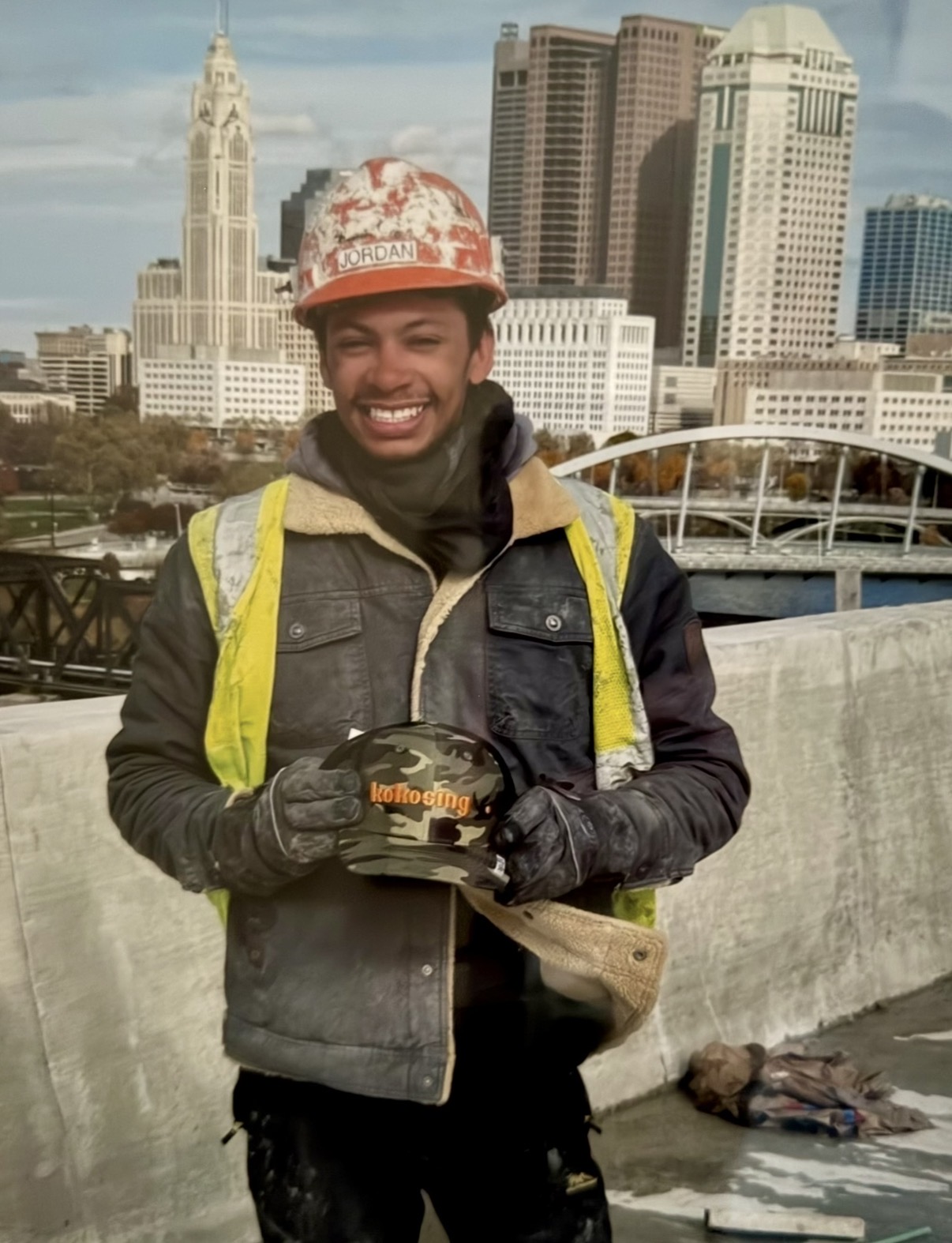
On February 28, 2026, my brother was killed by a reckless driver while he was working. He was 25 years old. I had always known that his job could be dangerous. I just never imagined there would be a day when he would leave for work and not come home.
To understand why I am building JORDAN, I want you to know the brother I grew up with, the man he was becoming, and how much of our future should still have had him in it.
Before JORDAN was a project, Jordan was my little brother.
I am the oldest of three: me, Jordan, and our youngest brother, Dakota. Jordan and I were two years, six months, and nine days apart. I don’t fully remember the day our mother brought him home from the hospital, but I remember the feeling that I was no longer alone. I made it my mission to be his protector. Whatever our mother, Christina, had to say about it, he was my baby.
When Jordan was little, it took him a while to become verbal, and I became his voice. Helicopters were “hopterdopters,” and anything white was simply “white.” He might have meant vanilla ice cream, whipped cream, white paint, or something else entirely, but somehow I always understood. He also had a particular love for the number five. Whatever we ordered, he wanted five of it: five fries, five chicken nuggets, five of whatever had caught his attention. Our mother always found a way to hand him his five. There was so much love in the patience she gave him.
Jordan unapologetically marched to the beat of his own drum. But if I listened long enough, I could hear that his drum was often playing the same tune as mine. He just arrived at it in his own time, in his own way.
He loved being outside. On our walks to school, he noticed the trees, the clouds, and the birds, the things most of us are too busy to see. He wanted to hold my hand, without any of the embarrassment another child might have felt about holding his sister’s hand. I imagine he felt he was protecting me, even as I was looking out for him. As much as I had claimed the role of protector, Jordan had his own ways of taking care of me.
Our childhood home in Akron, Ohio, gave him a whole world to explore. He would spend hours reading Diary of a Wimpy Kid in the tree outside, or searching for unusual rocks, hiding places, and strange little things to collect. Some discoveries became treasures; others became another way to taunt Dakota. His love of WWE also meant that watching wrestling was rarely the end of it. There were moves to reenact, and Dakota usually bore the brunt of those body slams.
With me, Jordan was the gentlest soul. He was the first person to show me what unconditional love looked like. When I cried, he gave me the biggest embrace. Our senses of humor were different, but he always found a way to make me laugh, whether it was a silly face or literally climbing the walls in our house to prove he was Spiderman. He loved superheroes and the worlds of Marvel and DC. I think that love helped draw him into gaming, which stayed with him into adulthood as a way to make friends, express himself, and enjoy life.
Music was one of the few things we could never quite agree on. Jordan loved Eminem, Tupac, Bone Thugs-N-Harmony, and 50 Cent in his prime. I shared his appreciation for old school hip hop, but Eminem and I never quite connected. Now, I wouldn’t dare skip an Eminem song. Something we once disagreed about has become another way I remember him.
Animals gravitated toward Jordan, and he welcomed every bit of their attention. He never met a dog he didn’t love or a cat he didn’t want to bring home. Our childhood dog, Lucy, was a Yorkie who made a run for it whenever someone opened the door. She was fast, but she could never outrun him. He always caught her, earning his place in our family as the Lucy whisperer.
Jordan was particular about who he let into his life. When he loved someone, he saw something special in them, including the parts they struggled to love in themselves. He was drawn to imperfections, and being loved by him made the world feel a little brighter and life a little simpler. He had a kind of goodness that came naturally to him, the kind many people spend their lives trying to learn.
He didn’t always have the right words, but his actions made his care unmistakable. He listened to understand you. He offered advice where he could and an embrace when words weren’t enough. People often say they would have held on longer if they had known a hug would be their last. Jordan gave that kind of hug every time. He lived fully in the moment he was in.
As he grew older, I loved watching him find his voice and connect with people who understood him. He was making friends, opening up to his coworkers, and showing the skills he had learned on the job. He was becoming more confident and more himself. There was so much of his life still unfolding, and it made me happy to see him beginning to make it his own.
That is part of what makes his death so difficult to accept. He had worked to find his place, and he deserved the time to keep growing into it.
I miss the days when I didn’t have to decide whether to say “is” or “was” when talking about Jordan.
It is such a small change in language to carry something so enormous.
The driver who killed Jordan took someone who belonged to so many lives. They took the uncle my future children and Dakota’s future children should still have, my mother’s anchor, and my cousin’s best friend. They took someone whose kindness reached far beyond our family. I call him the best person I have ever known because of the way he treated people and the love he gave so freely.
His death also took years of ordinary life together. Holidays will always carry his absence. Family photographs will always be missing someone. Our children will grow up without the years they should have had with their uncle. There is grief for the person we knew, and grief for all the life together we will never get to know.
My brother was where he was supposed to be.
Alongside that grief is an anger I cannot separate from the fact that he was at work. I cannot accept “right place, wrong time” as an explanation for his death. My brother was where he was supposed to be, doing work he had every right to come home from. There should never be a wrong time to earn a living, and no family should be asked to accept the loss of someone they love as an ordinary risk of that person’s job.
Jordan deserved a full life. He deserved more friendships, more games, more music, and more years with the people who loved him. The danger of his work did not make his future any less his to live.
The promise I made to him.
At his funeral, I promised that I would spend my life trying to be more like him and be his vessel here on Earth. JORDAN is one way I intend to keep that promise.
I cannot go back to February 28 or change what happened to my brother. I can put what I know, what I am able to build, and the love I will always have for him into work that I hope will help protect someone else.
JORDAN is being built to help workers report dangerous conditions, alert their crews, and bring concerns to the people who can respond. I want workers to have ways to communicate what they are facing while there is still time to act. Their safety deserves attention before another family has to explain what was lost.
My hope is that another mother gets her son home, another child gets more years with their father or mother, and another family keeps the brother, sister, uncle, or friend they love. I know how much of a life can be taken from the people who remain, and I want fewer families to have to know that grief.
There is no way to fit 25 years of being Jordan’s sister into a single page. There will always be another memory, another story, another part of him I wish I could share. But the love that made me want to protect him when we were children is still here. It is part of why I am doing this, and part of what I hope this work can offer to the people still out there, doing their jobs, with lives waiting for them beyond the end of a shift.